You're Not Due — You're Just Down: The Costly Lie Behind Every 'Next One's Mine' Moment
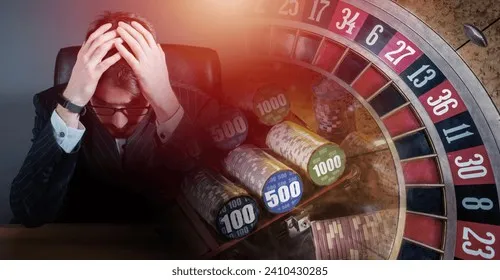
Photo: frustrated gambler staring at roulette wheel in casino, via www.shutterstock.com
It happens at the blackjack table. It happens at the slots. It happens watching the roulette ball drop for the sixth straight time on black when you've been hammering red. That voice in your head — calm, confident, almost logical — whispers: I'm due.
It's one of the most expensive thoughts in gambling. And the scary part? It feels completely reasonable.
What the Gambler's Fallacy Actually Is
The gambler's fallacy is the belief that past random events influence future random outcomes. Lose five coin flips in a row, and your brain starts screaming that heads is overdue. Hit a cold stretch at the craps table and suddenly every new roll feels like it's carrying the weight of all those losses, ready to tip the scales back in your favor.
Psychologists have studied this bias extensively, and it shows up everywhere — not just at the casino. But in gambling, where real money rides on each decision, it's uniquely destructive.
Here's the hard truth: a roulette wheel has no memory. Neither does a slot machine's random number generator. Neither does a deck of cards in a continuous shuffle machine. Each outcome is statistically independent of everything that came before it. The universe keeps no ledger. It doesn't owe you anything.
The Math That Doesn't Care About Your Feelings
Let's make this concrete. Say you're at an American roulette wheel — the one with both 0 and 00. The odds of hitting red on any single spin are 18/38, or roughly 47.4%. If red has come up ten times in a row, what are the odds it hits on the eleventh spin?
Still 47.4%.
Not 60%. Not 75%. Not "basically guaranteed." Forty-seven point four percent, exactly as it was on spin one.
The ten previous outcomes don't nudge the probability dial even a fraction. What does change is your emotional state — and that's where the real damage gets done.
When players believe they're "due," they tend to:
- Increase bet sizes to "make up" losses faster
- Extend sessions well past their planned stop point
- Chase losses in games they weren't originally playing
- Abandon sound bankroll strategy in favor of gut feeling
Every one of those behaviors accelerates losses. The house edge — already grinding away at your stack — gets to work on bigger bets, over more hands, while your decision-making gets cloudier by the minute.
Why Your Brain Is Wired to Fall for This
Humans are pattern-recognition machines. It's evolutionary. Our ancestors who noticed patterns — that particular rustle in the grass usually meant a predator — survived longer than those who didn't. That same wiring, brilliant for survival, is actively terrible for processing randomness.
When we see a streak of losses, our brains instinctively look for a corrective pattern. We feel the pull toward equilibrium. Statisticians call this "regression to the mean" — over a long enough sample, results do trend toward expected probabilities. But here's the catch: regression to the mean happens because of the overwhelming volume of future results, not because of some compensating force pulling things back into balance.
In plain English: if you flip a coin a million times, you'll end up close to 50/50 heads and tails — not because the coin "corrects" early streaks, but because a million future flips drown them out. Your ten-flip losing streak isn't corrected. It's just made statistically irrelevant by sheer volume.
You don't have a million flips. You have whatever's left in your session bankroll.
Real Scenarios Where This Gets Expensive
The Slot Spiral: A player sits down with $200, hits nothing substantial in the first 45 minutes, and starts doubling bet sizes convinced a big payout is "loaded and ready." The RNG doesn't know or care about the previous spins. The bigger bets just mean the inevitable losing spins cost more.
The Sports Betting Revenge Game: A bettor goes 1-4 on a Sunday slate, then hammers a Monday Night Football game at 2x their normal unit size to "get even." That game carries the same house edge as every other bet. The only thing different is the emotional pressure attached to it.
The Blackjack Bad Run: A solid basic strategy player takes a beating over 30 hands and starts deviating — hitting when they should stand, doubling when they shouldn't — because they're convinced variance has to swing their way soon. It doesn't. And now they've added poor strategy on top of bad luck.
Mental Frameworks That Actually Help
Knowing the fallacy exists doesn't automatically protect you from it. Here's what does:
Treat each bet as its own isolated event. Before placing your next wager, ask yourself: "If I were starting fresh right now, with no knowledge of what just happened, would I make this exact bet at this exact size?" If the honest answer is no, you're probably chasing.
Anchor to your session plan, not your session results. Decide your stop-loss and target before you start playing. Losses don't change those numbers. The plan exists precisely to override the emotional math your brain does mid-session.
Use the "stranger test." Imagine a stranger walks up and sees your current bet. They have no idea what happened in the last hour. Would that bet look reasonable to them? If your answer is "only if they knew how cold I've been running," that's the fallacy talking.
Recognize the physical signals. Chasing behavior often comes with physical tells — tightness in the chest, faster breathing, a sense of urgency. Those feelings are real information. They're telling you that emotion has taken the wheel from logic.
The Boldest Play Is Knowing When to Walk
At BWFun88, we believe bold play is smart play. And sometimes the boldest, smartest move is closing the table, stepping away from the screen, and refusing to let a cognitive bias dictate your bankroll decisions.
The house edge is already a built-in headwind. It doesn't need your help. Every bet placed because you "feel due" is a bet placed with worse judgment than the one before it — and the math was already stacked slightly against you to begin with.
You're not due for a win. You're just a player who's had a rough stretch, and the next spin, hand, or roll has absolutely no obligation to fix that. Accepting that reality — truly accepting it, not just knowing it intellectually — is what separates recreational players from genuinely sharp ones.
The cards don't owe you. But your future self will thank you for playing like they do.